



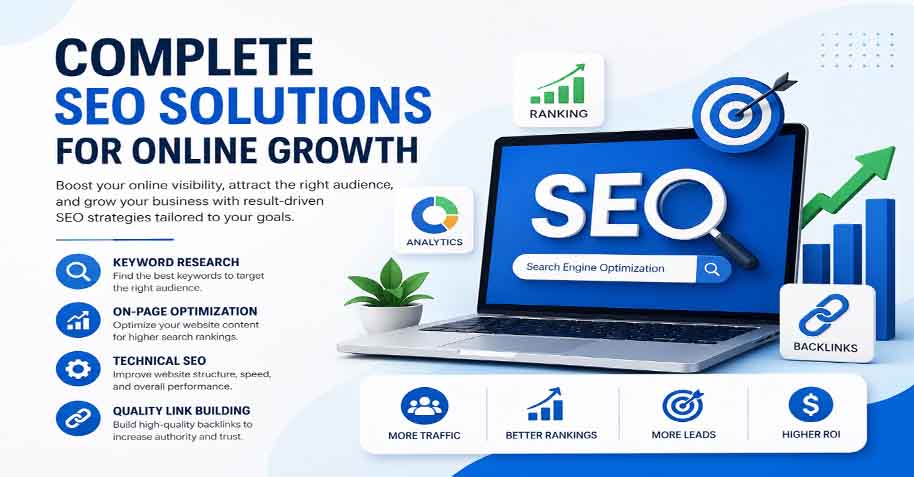
Complete SEO Solutions for Online Growth
Introduction to Modern SEO Solutions for Businesses
In the modern digital economy, businesses are continuously competing for visibility, customer attention, and market share. Having a website alone is no longer enough to achieve growth because millions of businesses are fighting for positions on search engines every day. This is where complete SEO solutions for online growth become essential. Search engine optimization is not simply a marketing trend; it is a long-term business strategy designed to increase visibility, attract relevant audiences, generate leads, and improve conversion opportunities. Companies that invest in SEO create stronger foundations for digital success while building sustainable online authority.
Search engines have become the primary way customers discover products, services, and solutions. Whether customers are searching for local businesses, online stores, service providers, or educational resources, appearing in top search results dramatically improves opportunities for growth. Businesses that implement advanced optimization strategies are often able to outperform competitors while reducing dependency on expensive advertising campaigns. SEO creates long-lasting value because optimized content and technical improvements continue generating traffic over time.
Understanding Complete SEO Solutions and Their Importance
Complete SEO solutions involve multiple components working together rather than focusing on only one optimization area. Many businesses mistakenly believe SEO is only about keywords or backlinks, but modern optimization requires technical expertise, strategic planning, content development, analytics tracking, user experience improvements, and continuous updates. Every part of the optimization process contributes toward improved search visibility and stronger digital performance.
Businesses investing in SEO often notice improvements Advanced Search Engine Optimization Services for Sustainable Business Growth beyond search rankings. Better optimization frequently leads to improved user experiences, stronger website performance, increased trust among visitors, and higher conversion rates. Customers naturally trust businesses that appear prominently within search results because visibility often creates credibility. A properly optimized website provides value both for search engines and human visitors, creating a balanced approach toward long-term growth.
SEO also helps businesses establish authority within their industries. When users repeatedly encounter helpful, optimized content from the same company, brand recognition grows naturally. This increased visibility creates stronger customer relationships while supporting long-term business expansion.
Building a Strong SEO Foundation Through Strategic Planning
Effective SEO campaigns always begin with strategy. Businesses that start optimization without planning often waste resources targeting the wrong audiences or focusing on ineffective tactics. Strategic planning involves understanding customer behavior, analyzing competitors, evaluating opportunities, and creating measurable objectives.
Keyword research plays an important role in strategic planning because it helps businesses understand customer intent. Research reveals what users search for, how competitive specific phrases are, and which opportunities provide the greatest potential returns. Strong SEO strategies combine informational keywords, transactional phrases, local terms, and long-tail opportunities.
These keyword phrases target highly relevant search intent while supporting broader visibility objectives.
Planning also requires businesses to establish performance indicators. Traffic growth, rankings, engagement metrics, conversion rates, and lead generation goals provide measurable benchmarks that guide optimization efforts. Without measurable objectives, businesses struggle to evaluate SEO effectiveness.
Technical SEO as the Backbone of Search Performance
Technical SEO creates the infrastructure required for strong search performance. Even exceptional content may fail when websites suffer from technical limitations that prevent efficient crawling, indexing, or user engagement. Search engines prioritize websites that provide fast, secure, and accessible experiences.
Website speed optimization has become increasingly important because users expect immediate access to information. Slow-loading pages increase bounce rates while reducing engagement opportunities. Improving server performance, optimizing images, reducing unnecessary scripts, and improving code efficiency help websites load faster and perform better.
Mobile optimization is equally important because mobile devices generate significant portions of global search traffic. Responsive websites adapt to different screen sizes while maintaining usability and readability. Search engines reward mobile-friendly experiences because they align with modern user behavior.
Technical optimization also includes structured website architecture. Proper URL structures, XML sitemaps, internal linking systems, and crawl optimization help search engines understand website organization. These improvements strengthen indexing efficiency and improve overall visibility.
Security is another major ranking factor. HTTPS implementation protects users while improving trust. Search engines increasingly prioritize secure websites because user protection remains essential within modern digital ecosystems.
Content Marketing and SEO Working Together
Content serves as one of the strongest components of successful optimization strategies. Search engines aim to provide users with valuable, informative, and trustworthy information. Businesses that consistently publish useful content improve authority while increasing ranking opportunities.
Content marketing supports SEO because it expands keyword coverage and improves topical relevance. Educational resources, service descriptions, blog posts, guides, and informational pages create multiple opportunities for search visibility. High-quality content addresses customer questions while guiding visitors toward solutions.
Creating content requires understanding user intent. Informational searches require educational content, while transactional searches require conversion-focused pages. Businesses that align content with intent improve engagement metrics while increasing conversions.
Long-form content often performs particularly well because it provides comprehensive answers and encourages longer user engagement. Detailed resources naturally attract backlinks and social shares while improving authority signals.
Content optimization should also include strategic internal linking. Connecting related pages improves navigation while distributing authority across websites. These improvements help users discover additional information while supporting stronger indexing.
On-Page SEO Optimization for Better Visibility
On-page optimization ensures content communicates relevance clearly to search engines. Every page element contributes toward stronger rankings when optimized effectively.
Title tags remain one of the most important components because Comprehensive SEO Strategies for Long-Term Organic Traffic Success they influence both rankings and click-through rates. Effective titles balance keyword relevance with compelling messaging that encourages user engagement.
Meta descriptions provide additional opportunities to attract clicks from search results. Although descriptions may not directly impact rankings, compelling summaries influence traffic performance.
Headers improve readability while helping search engines understand page structure. Organized heading systems create logical content hierarchies that benefit both users and crawlers.
Image optimization supports faster loading times while improving accessibility. Proper compression, descriptive filenames, and alt text contribute toward better performance and broader visibility opportunities.
URL structures should remain simple and descriptive. Clean URLs improve usability while providing clearer relevance signals to search engines.
Authority Building Through Ethical Link Development
Search engines evaluate authority partly through backlink quality. Strong websites naturally attract references from trusted sources, signaling credibility and expertise.
Link-building strategies should focus on earning high-quality links rather than accumulating large volumes of low-quality backlinks. Guest contributions, partnerships, educational resources, industry publications, and digital public relations campaigns create sustainable authority growth.
Creating valuable resources often increases natural link acquisition. Research studies, guides, tutorials, and original insights encourage other websites to reference useful content.
Building authority also requires consistency. Websites that continuously publish strong content and maintain optimization efforts gradually strengthen domain credibility.
Local SEO and Geographic Search Opportunities
Local businesses require specialized optimization strategies because geographic relevance influences rankings. Customers frequently search for nearby services, making local visibility critical.
Local optimization includes location-specific content, business profile optimization, citation management, and customer reviews. These elements strengthen geographic relevance signals while increasing trust.
Customer reviews play a particularly important role because they influence purchasing decisions while contributing toward local rankings. Positive experiences shared publicly create stronger credibility.
Businesses serving multiple locations should develop dedicated pages for each service area. These pages improve relevance while expanding keyword opportunities.
Analytics and Continuous SEO Improvement
SEO success depends heavily on data analysis. Optimization strategies require regular monitoring because search behavior and competition continuously evolve.
Analytics platforms help businesses evaluate Professional Website Optimization Services for Higher Search Rankings traffic sources, conversion performance, engagement patterns, and ranking changes. These insights guide future decisions while identifying weaknesses.
Continuous optimization allows businesses to respond quickly to algorithm updates and market changes. SEO should never remain static because digital environments constantly shift.
Testing also plays an important role. Businesses should regularly evaluate content performance, page designs, and optimization tactics to discover improvements.
Long-Term Value of Investing in SEO Solutions
One major advantage of SEO is sustainability. Paid advertising stops generating traffic when budgets disappear, but optimized websites continue attracting users long after implementation.
SEO investments often create compounding benefits because authority, content libraries, and backlinks strengthen over time. Businesses with long-term optimization strategies frequently achieve stronger returns than competitors relying solely on short-term campaigns.
Sustainable growth requires patience because rankings rarely improve overnight. However, businesses maintaining consistent efforts usually experience stronger traffic, improved visibility, and increased customer acquisition.
Conclusion
Complete SEO solutions for online growth provide businesses with powerful opportunities to expand visibility, strengthen authority, and improve long-term performance. Effective optimization combines technical improvements, content strategies, keyword research, user experience enhancements, and continuous monitoring into a unified strategy designed for sustainable results.
Businesses operating within competitive markets cannot rely solely on traditional marketing approaches. Strong SEO strategies allow companies to connect with customers during every stage of the buying process while building stronger digital foundations. Organizations that prioritize comprehensive optimization position themselves for continued success within evolving online environments.
Long-term growth requires consistency, adaptability, and strategic planning. Businesses implementing complete SEO solutions create scalable systems capable of supporting future expansion while maximizing digital opportunities. Through ongoing optimization efforts, companies transform websites into valuable business assets that continuously generate traffic, leads, and revenue over time.
Comments