



B2B Customer Portal Development in Pakistan: A Complete Guide for Growing Businesses
Many businesses in Pakistan still manage their wholesale orders, customer enquiries, pricing, invoices, and business communication through phone calls, WhatsApp messages, emails, and spreadsheets. Although these methods may work when a business is small, they often become difficult to manage as the number of customers and daily orders increases.
Manufacturers, wholesalers, distributors, and suppliers need a more organised way to handle business relationships and daily operations. A dedicated online portal can help businesses simplify these processes, reduce manual work, and provide customers with a better experience.
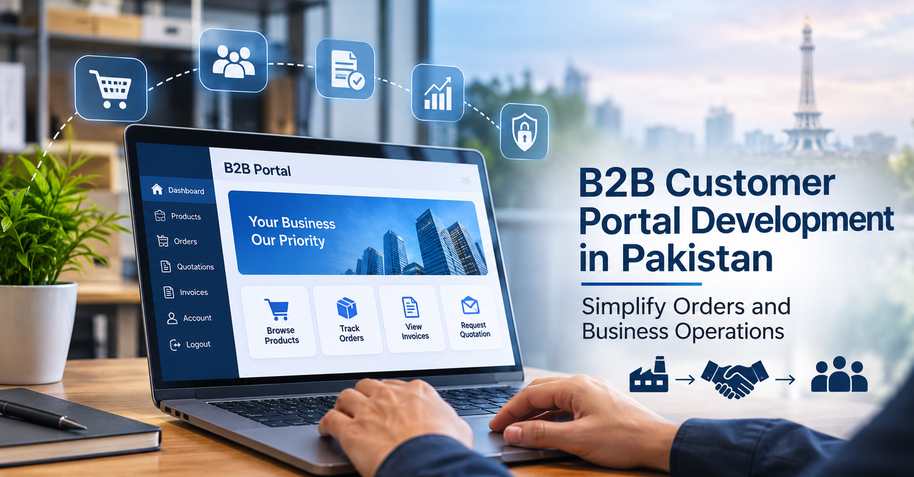
B2B Customer Portal Development allows businesses to create a central online platform where approved customers can access product information, place orders, request quotations, track deliveries, and manage their accounts. Instead of depending on repeated calls and manual communication, businesses can provide customers with a convenient digital system.
For Pakistani companies planning to improve their operations, a customised customer portal can become an important part of long-term business growth.
What Is a B2B Customer Portal?
A B2B customer portal is a secure online platform designed for businesses that sell products or services to other businesses. It gives registered customers access to specific information and services through their own accounts.
For example, a wholesale distributor can provide retailers with an online catalogue, customer-specific prices, bulk ordering options, order history, and invoice details. Customers can log in whenever they need information instead of contacting the sales team for every small request.
Unlike a standard online shopping website, a B2B portal is designed around business relationships. It can support negotiated prices, bulk quantities, approval processes, different customer roles, and customised ordering requirements.
Why Pakistani Businesses Need a Digital Customer Portal?
As businesses grow, managing customer communication and orders manually can consume valuable time. Employees may need to answer the same questions repeatedly, confirm product availability, share updated price lists, and provide order status information.
A customer portal brings these activities into one organised system.
- Simplified order management: Customers can browse products, select quantities, and submit orders through their accounts. This reduces dependence on manual order collection and helps minimise communication errors.
- Better customer experience: Customers can access important information at their convenience. They do not always need to wait for a sales representative to respond to basic enquiries.
- Customer-specific pricing: Different distributors or retailers may have different price agreements. A portal can display the correct prices according to each customer's account.
- Improved order visibility: Customers can check order progress, previous purchases, and relevant updates without repeatedly contacting the business.
- Reduced administrative workload: Employees can spend less time handling repetitive requests and focus more on sales, customer relationships, and business development.
For businesses dealing with multiple clients, these improvements can make daily operations more manageable.
Important Features of a Successful B2B Portal
A useful customer portal should be designed around the actual requirements of the business. Adding unnecessary features can increase complexity, while missing essential functions can limit the platform's value.
- Secure customer accounts: Each business customer should have a separate login with access to relevant products, prices, orders, and account information.
- Product catalogue: Customers should be able to browse products, view descriptions, check specifications, and find relevant information easily.
- Bulk ordering: Wholesale customers often purchase products in larger quantities. The portal should make it simple to select products and submit bulk orders.
- Custom pricing: Businesses should be able to manage different prices, discounts, and purchasing conditions for different customer groups.
- Order tracking: Customers should have access to order status updates, helping them understand whether an order is pending, processed, dispatched, or completed.
- Quotation management: Some B2B transactions require quotations before an order is confirmed. A portal can allow customers to submit quotation requests and review responses.
- Invoice and payment information: Depending on business requirements, customers may be able to view invoices, payment records, and outstanding balances.
- Admin dashboard: Administrators need a central place to manage customers, products, orders, pricing, and portal activity.
The exact feature set should depend on the company's business model, customer expectations, and existing processes.
Custom Portal Development vs a Standard E-commerce Website
A standard e-commerce website is generally designed to sell products directly to individual customers. It usually focuses on product browsing, shopping carts, online payments, and order confirmation.
B2B businesses often require more advanced functionality.
For example, a manufacturer may work with distributors who receive negotiated prices. A supplier may need to approve orders before processing them. A wholesaler may offer credit terms to selected customers. These requirements are not always supported by a basic e-commerce setup.
Custom B2B Portal Development makes it possible to build a platform around these specific business processes.
A customised portal can include different customer roles, special pricing rules, bulk order workflows, quotation approvals, and integrations with existing business software. This gives companies greater control over how customers interact with their services.
The objective is not simply to create another website. It is to build a practical digital system that supports the way the business operates.
Integrations That Make a Portal More Effective
A customer portal becomes more useful when it connects with the software a business already uses.
For example, integration with an inventory management system can help display updated stock information. CRM integration can make customer records and sales activities easier to manage. ERP integration can connect orders with internal business operations.
Other useful integrations may include:
- Payment gateways for online transactions.
- Accounting software for invoices and financial records.
- Inventory systems for product availability.
- CRM platforms for customer management.
- Shipping or delivery systems for order updates.
Before development begins, businesses should identify which systems need to communicate with the portal. Proper integration planning helps avoid duplicate data entry and disconnected workflows.
How to Plan a B2B Customer Portal?
A successful project begins with understanding the business rather than immediately choosing features or technology.
The first step is to identify the main problems the portal should solve. A manufacturer may want to simplify distributor orders, while a wholesaler may want to provide customers with updated prices and product availability.
Next, the business should define customer roles and permissions. Not every customer needs access to the same information. Some users may only place orders, while others may manage multiple employees or review account details.
The design should make important actions easy to find. Customers should be able to log in, browse products, place orders, and check updates without unnecessary steps. A responsive design is also important because customers may access the portal through mobile phones, tablets, or desktop computers.
Development should include testing of important workflows, including account registration, login security, pricing rules, order submission, notifications, and integrations. Testing helps identify problems before the platform becomes available to customers.
Finally, the business should plan for ongoing maintenance, security updates, performance improvements, and future feature requirements.
Security, Cost, and Common Development Mistakes
Because a B2B portal may contain customer records, pricing information, invoices, and business transactions, security should be considered from the beginning.
Secure authentication, role-based permissions, encrypted connections, regular backups, and software updates can help protect the platform. Businesses should also ensure that users can only access the information relevant to their accounts.
The development cost in Pakistan depends on the portal's complexity. A basic portal with customer accounts, product listings, and order management will generally require less development work than a platform with advanced pricing rules, ERP integration, multiple approval levels, and custom dashboards.
Other factors affecting cost include design requirements, technology selection, data migration, testing, hosting, and ongoing support. Businesses should define their essential requirements before requesting a development estimate.
Some common mistakes can also affect project success. These include choosing a generic system without reviewing business needs, ignoring mobile usability, adding unnecessary features, overlooking security, and failing to plan for future growth.
A well-planned portal should be practical, secure, easy to use, and flexible enough to support changing business requirements.
Why Choose HubSol for Your B2B Portal Project?
Choosing the right development partner is important because a customer portal needs more than an attractive design. It requires a clear understanding of business workflows, customer requirements, functionality, and long-term scalability.
HubSol provides web development and custom digital solutions for businesses looking to improve their online operations. The development approach should focus on understanding your business model and creating a platform that supports your actual requirements.
With professional B2B Portal Development Services, manufacturers, wholesalers, distributors, and suppliers can work towards a more organised digital customer experience.
Whether you need customer accounts, product catalogues, custom pricing, bulk ordering, quotation management, or integrations with existing business systems, the right development strategy can help turn your requirements into a practical online platform.
Explore HubSol's services at https://www.hubsol.com/services.html and discuss your project requirements with the team.
Frequently Asked Questions
What is the main purpose of a B2B customer portal?
Its main purpose is to provide business customers with a secure online platform to access products, prices, orders, invoices, and other relevant services.
Can a B2B portal display different prices for different customers?
Yes. A customised portal can use customer groups, account-specific pricing, negotiated rates, and discount rules according to business requirements.
Is a B2B customer portal suitable for small businesses?
Yes. Small businesses can start with essential features and expand the platform as their customer base and operational requirements grow.
Can a B2B portal connect with existing business software?
Yes. Depending on the available systems and technical requirements, a portal can integrate with CRM, ERP, inventory, accounting, and payment solutions.
How long does it take to develop a B2B portal?
The timeline depends on the number of features, design complexity, integrations, and testing requirements. A clearly defined project scope helps establish a realistic development schedule.
Final Thoughts
Businesses that depend on manual ordering, repeated customer communication, and disconnected systems may find it increasingly difficult to manage operations as they grow. A dedicated B2B portal can bring important customer services into one accessible platform.
From product browsing and bulk ordering to custom pricing and order tracking, the right solution can improve efficiency and create a more professional experience for business customers.
If your company is planning to modernise its ordering process or build a dedicated customer platform, visit HubSol and explore how HubSol can help you plan your next digital project.
Comments